
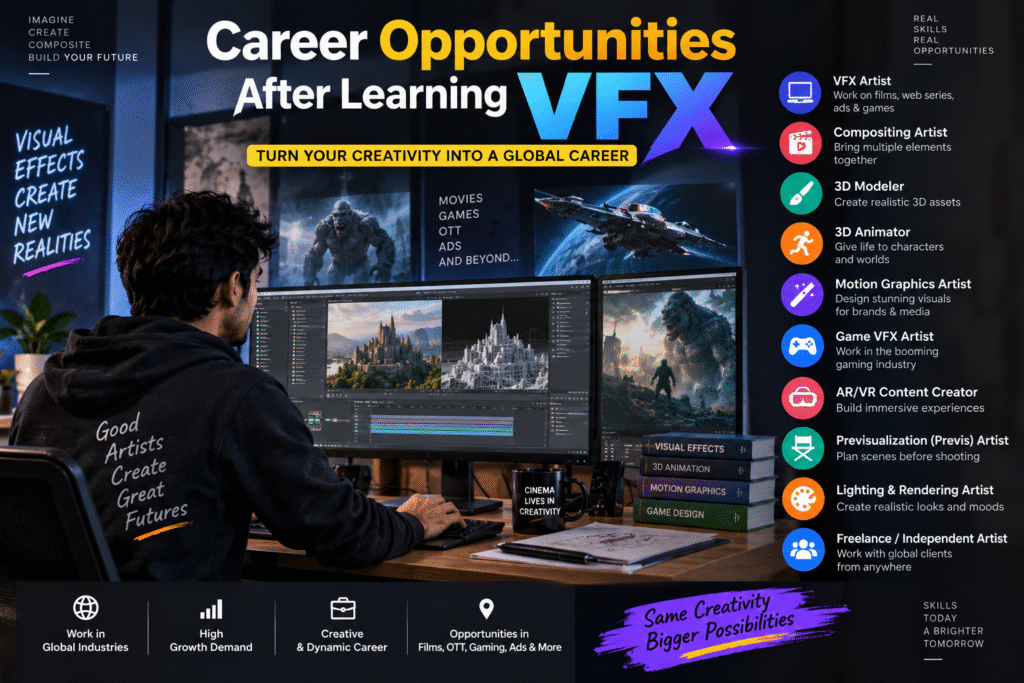
What Career Opportunities Are Available After Learning VFX?
Students who learn VFX can explore careers in film production, OTT content, advertising, animation, gaming, video production, post-production and freelance creative services.
VFX Course is not limited to movies. Modern visual-content production uses skills such as compositing, motion graphics, 3D animation, video editing, rotoscoping, camera tracking, CGI, visual effects and color correction.
What Is VFX?
VFX, or Visual Effects, is the process of creating, modifying or combining visual elements to produce scenes that may be difficult, expensive or impossible to capture entirely in-camera.
VFX is used across films, OTT platforms, television, advertising, music videos, gaming, YouTube, corporate videos, product videos and digital content.
Top Career Opportunities After Learning VFX
- VFX Artist
A VFX artist works on visual effects used in films, advertisements, digital content and other productions. - Compositor
A compositor combines multiple visual elements into a final image or sequence, including live-action footage, CGI, backgrounds and effects. - 3D Artist
A 3D artist creates or works with three-dimensional models and environments. Areas include 3D modeling, texturing, lighting and rendering. - Motion Graphics Designer
Motion graphics combine graphic design and animation and are used in advertisements, social media, YouTube, corporate videos and explainer videos. - Video Editor
Students who learn VFX alongside video editing can work on YouTube videos, reels, advertisements, films, corporate videos, music videos and social media content. - Rotoscopy Artist
A rotoscopy artist isolates or traces objects and people from footage for use in visual-effects production. - 3D Animator
A 3D animator creates movement for digital characters, objects and environments. - Game Artist
VFX and 3D skills can be useful in gaming for game assets, environment design, character effects, particle effects and 3D assets. - Advertising and Creative Production
VFX professionals can work on product advertisements, brand videos, social media campaigns, promotional videos and digital advertisements. - Freelance VFX Professional
Freelancers may provide video editing, motion graphics, compositing, YouTube editing, 3D services and visual effects.
VFX Career After 12th
VFX Fundamentals → Video Editing → Compositing → Motion Graphics → 3D Fundamentals → Tracking & Rotoscopy → Practical Projects → Portfolio/Showreel → Internship/Job/Freelancing
What Skills Should a VFX Student Learn?
Technical skills include video editing, compositing, 3D modeling, animation, motion graphics, rotoscopy, camera tracking, lighting, rendering and color correction.
Creative skills include visual storytelling, composition, design, timing, creativity and attention to detail.
Why Is a VFX Portfolio Important?
A VFX portfolio or showreel can demonstrate compositing, motion graphics, 3D work, video editing and visual effects. Students should regularly add their strongest work to their portfolio.
Is VFX a Good Career in 2026?
VFX Course in Nanded can be a good career option for students who enjoy visual storytelling, animation, design and technology. Success depends on practical ability. Learning software alone is not enough; a stronger combination is Software Skills + Creative Skills + Projects + Portfolio + Industry Understanding.
Does AI Affect VFX Careers?
AI is changing creative workflows, including image generation, video production and post-production. Students should learn fundamental VFX skills while becoming comfortable with relevant AI-assisted creative tools.
VFX vs Video Editing
Video editing focuses on cutting footage, storytelling, audio, transitions, color and pacing. VFX Course in Nanded focuses more heavily on visual effects, compositing, CGI, tracking, rotoscopy and 3D. Students can learn both to become more versatile creative professionals.
Where Can VFX Professionals Work?
Possible work environments include VFX studios, animation studios, film production companies, advertising agencies, gaming companies, post-production studios, media companies, content agencies, freelance businesses and YouTube/content production teams.
Final Answer
Career opportunities after learning VFX include VFX Artist, Compositor, 3D Artist, Motion Graphics Designer, Video Editor, Rotoscopy Artist, 3D Animator, Game Artist and freelance creative professional.
The strongest strategy is: Learn the fundamentals → practice regularly → create projects → build a showreel → gain practical experience → apply for jobs or freelance projects.
Frequently Asked Questions
What jobs can I get after learning VFX?
You can explore roles such as VFX Artist, Compositor, 3D Artist, Motion Graphics Designer, Video Editor, Rotoscopy Artist and 3D Animator.
Is VFX a good career after 12th?
Yes. Students interested in animation, visual effects, design, film and digital content can consider VFX as a career-oriented skill.
Do I need drawing skills to learn VFX?
Not every VFX role requires advanced drawing skills. However, visual understanding, creativity, composition and attention to detail can be valuable.
Can I freelance after learning VFX?
Yes. VFX-related freelance services can include video editing, motion graphics, compositing, YouTube editing, 3D work and visual effects.
What should I include in a VFX portfolio?
Include your strongest VFX projects, compositing work, motion graphics, 3D work, editing projects and before-and-after examples in a concise showreel.
Is AI replacing VFX artists?
AI is changing VFX workflows rather than eliminating the need for all VFX professionals. Students should learn fundamental VFX skills while also becoming comfortable with relevant AI-assisted creative tools.